
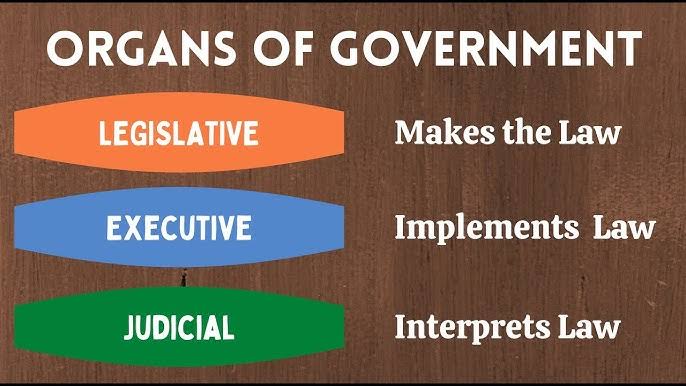
Effective governance in modern democratic states relies on a clear division of labor and authority among distinct branches, commonly referred to as the organs of government. This fundamental principle, known as the separation of powers, aims to prevent the concentration of power in any single entity, thereby safeguarding liberty, promoting accountability, and ensuring the rule of law. Each organ—the Legislature, the Executive, and the Judiciary—possesses unique functions, powers, and limitations, which are crucial for the balanced operation of the state.
1. The Legislature: The Law-Making Body
The Legislature is the deliberative body responsible for creating, amending, and repealing laws. It serves as the primary representative of the people, translating societal needs and values into legal frameworks.
Types: Legislatures can broadly be classified into two types based on their structure:
- Unicameral: Consisting of a single chamber or house. Examples include the parliaments of New Zealand and Denmark, where legislative processes are typically faster due to fewer procedural hurdles.
- Bicameral: Comprising two chambers or houses. This is more common in larger, federated states, allowing for broader representation and more thorough deliberation. Examples include the U.S. Congress (House of Representatives and Senate) and the UK Parliament (House of Commons and House of Lords). The houses often have different bases of representation, such as population (lower house) and states/regions or specific societal groups (upper house).
Structure: In a bicameral system, the lower house (e.g., House of Representatives, House of Commons, National Assembly) is typically the more powerful body, directly elected by the populace, and often holds the primary legislative and financial authority. The upper house (e.g., Senate, House of Lords, Council of States) usually provides a check on the lower house, offering a platform for review, revision, and representation of specific interests (e.g., states in a federation, experts, or historical estates).
Composition/Membership: Members of the legislature, often called parliamentarians, senators, or representatives, are primarily chosen through popular elections, usually based on geographical constituencies. Eligibility criteria widely include age, citizenship, and residency. In some systems, particularly for upper houses, members may be appointed (e.g., Canadian Senate) or hold hereditary seats (e.g., UK House of Lords). Term lengths vary considerably, from two to six years.
Functions:
- Law-making (Legislation): The primary function is to debate, amend, and enact statutory laws.
- Representation: To voice the interests and concerns of their constituents and various societal groups.
- Oversight of the Executive: To scrutinize the actions of the government, including reviewing policies, questioning ministers, and conducting investigations.
- Financial Control: To approve the national budget, levy taxes, and authorize government spending.
- Constitutional Amendment: To propose and ratify changes to the constitution (often requiring supermajorities).
- Treaty Ratification: In many systems, the legislature must approve international treaties.
Powers:
- Enact and repeal laws.
- Approve national budgets and taxation.
- Declare war (in some systems, like the U.S.).
- Impeach or remove executive officials or judges (in presidential systems).
- Hold inquiries and summon witnesses.
Limitations: Legislatures are not omnipotent. Their powers are limited by:
- Constitutional Constraints: The national constitution often defines the scope of their legislative authority.
- Judicial Review: Courts can declare laws unconstitutional.
- Executive Veto: The head of the executive can reject proposed legislation, though this can often be overridden by a supermajority vote.
- Public Opinion and Elections: Legislators are accountable to the electorate and face re-election.
- Separation of Powers: They cannot typically enforce laws or adjudicate disputes.
2. The Executive: The Implementing Body
The Executive is the branch of government responsible for implementing and enforcing laws, managing the day-to-day affairs of the state, and formulating foreign policy. It embodies the administrative and leadership functions of the government.
Types: Executive systems primarily fall into two categories:
- Presidential System: The head of government (President) is directly elected by the people and is separate from the legislature. The President serves a fixed term and typically appoints their own cabinet, who are accountable to the President. Examples include the United States and Brazil.
- Parliamentary System: The head of government (Prime Minister/Chancellor) is usually the leader of the majority party or coalition in the legislature and is accountable to the legislature. The head of state (e.g., a monarch or a ceremonial president) is often separate from the head of government. Examples include the United Kingdom, Canada, and Germany.
Structure: The Executive typically comprises the Head of State (e.g., President, Monarch), the Head of Government (e.g., President, Prime Minister), the Cabinet (ministers leading various government departments), and the vast civil service/public administration responsible for carrying out government policies.
Composition/Membership:
- Head of State/Government: Chosen through direct election (Presidential) or by the legislature (Parliamentary).
- Cabinet Members: Appointed by the Head of Government, often from within the legislature (Parliamentary) or from outside (Presidential), and usually head specific ministries (e.g., Defence, Finance, Education).
- Civil Service: A permanent, professional, and politically neutral body of government employees implementing policies.
Functions:
- Law Enforcement: Administering and enforcing the laws passed by the legislature.
- Policy Implementation: Translating legislative mandates into actionable policies and programs.
- Foreign Relations: Conducting diplomacy, negotiating treaties, and representing the nation on the international stage.
- National Defense: Commanding the armed forces and ensuring national security.
- Budget Proposal: Formulating and proposing the national budget to the legislature.
- Appointments: Appointing various officials, including ambassadors, judges, and civil servants.
Powers:
- Veto power over legislation (Presidential systems).
- Issue executive orders or decrees that have the force of law.
- Command the armed forces.
- Negotiate and sign international treaties.
- Appoint high-ranking officials.
- Clemency/Pardons.
Limitations: The Executive’s powers are constrained by:
- Legislative Oversight: The legislature can question, investigate, and even remove (impeach) executive officials.
- Judicial Review: Courts can declare executive actions unconstitutional or illegal.
- Constitutional Limits: The constitution defines the scope of executive authority.
- Term Limits: Many executive heads have fixed terms and cannot serve indefinitely.
- Public Opinion and Media Scrutiny: Accountability to the public and transparency are vital.
- Budgetary Control: Dependence on legislative approval for funding.
3. The Judiciary: The Adjudicating Body and Judicial Independence
The Judiciary is the system of courts and judges responsible for interpreting laws, administering justice, and resolving legal disputes. It acts as the guardian of the constitution and the protector of individual rights.
Types: The judiciary is typically organized hierarchically, with different types of courts having specific jurisdictions:
- Trial Courts (Courts of First Instance): Where cases are initially heard, evidence is presented, and facts are determined (e.g., District Courts, Magistrates’ Courts).
- Appellate Courts: Review decisions made by lower courts, focusing on questions of law rather than facts (e.g., Courts of Appeal).
- Supreme Court (or High Court/Constitutional Court): The highest judicial body, whose decisions are final and binding, often addressing constitutional matters and setting legal precedents.
- Specialized Courts: Courts dealing with specific areas of law, such as administrative courts, family courts, or commercial courts.
Structure: The judicial system typically forms a pyramid, with a multitude of lower courts feeding into fewer appellate courts, culminating in a single supreme court or highest judicial body. Jurisdiction defines which cases each court can hear (e.g., civil, criminal, constitutional).
Composition/Membership: Judges are appointed or elected to serve in various courts. Qualifications typically include extensive legal education, significant practical experience (e.g., as lawyers or academics), and a strong record of ethical conduct. In many systems, judges are appointed by the executive or legislature, often after extensive vetting by judicial commissions or parliamentary committees. They commonly serve until retirement age or are subject to removal only for serious misconduct.
Functions:
- Interpreting Laws: To clarify the meaning and application of statutes and constitutional provisions.
- Administering Justice: To adjudicate civil disputes (e.g., contract disputes, torts) and criminal cases (e.g., theft, murder).
- Protecting Rights: To safeguard the constitutional and legal rights of individuals and groups against infringement by the state or other entities.
- Judicial Review: To determine the constitutionality of legislative acts and executive actions.
- Setting Precedent: In common law systems, judicial decisions create precedents that guide future judgments.
Powers:
- Adjudicate cases and pass judgments.
- Issue injunctions and orders.
- Declare laws or executive actions unconstitutional (judicial review).
- Interpret treaties and international law.
- Grant remedies for grievances.
Limitations: The judiciary’s powers are subject to:
- Dependence on Executive for Enforcement: Courts rely on the executive to enforce their judgments.
- Legislative Power to Modify Jurisdiction: Legislatures can define or alter the jurisdiction of courts (within constitutional limits).
- Constitutional Amendments: The constitution can be amended to overturn judicial decisions.
- Self-Restraint: Judges typically avoid making policy, leaving it to the elected branches.
- No Power of the Purse or Sword: It neither controls national finances nor commands armies.
Judicial Independence
Definition: Judicial independence is the principle that the judiciary should be kept separate from other branches of government and should not be subject to improper influence from other branches of government, or from private or partisan interests. It ensures that judges can make decisions based solely on the law and the facts presented, without fear of reprisal or expectation of reward.
Importance:
- Upholding the Rule of Law: Independent judiciaries ensure that everyone, including the government, is subject to the law.
- Protecting Rights and Freedoms: It allows courts to act as impartial arbiters, safeguarding the constitutional rights of citizens against potential overreach by the executive or legislature.
- Maintaining Public Trust: Public confidence in the justice system relies on its perceived impartiality and fairness.
- Checks and Balances: An independent judiciary is a crucial component of the system of checks and balances, preventing the abuse of power by other branches.
- Economic Stability: Predictable and fair legal systems are vital for investment and economic growth.
Mechanisms to Ensure Judicial Independence:
- Security of Tenure: Judges typically serve until a mandatory retirement age and can only be removed through a complex, stringent impeachment process for gross misconduct, not for unpopular decisions.
- Financial Security: Judges’ salaries and benefits are often constitutionally protected and cannot be reduced, ensuring they are not beholden to the executive or legislature for their livelihood.
- Immunity from Suit: Judges are generally immune from civil liability for actions taken in their judicial capacity.
- Non-Partisan Appointment Process: Systems often employ judicial commissions or require legislative confirmation to depoliticize judicial appointments.
- Contempt of Court Powers: Courts have the power to punish those who undermine their authority or obstruct justice.
- Institutional Separation: Physical and administrative separation of the judiciary from other branches.
- Professional Ethics: A strong code of conduct and ethical standards for judges.
Conclusion
The Executive, Legislature, and Judiciary are the foundational pillars of democratic governance, each endowed with distinct yet interconnected roles. While the Legislature crafts the laws, the Executive implements them, and the Judiciary interprets and upholds them, ensuring their lawful application and protecting the rights of citizens. The robust principle of judicial independence is particularly critical, serving as the ultimate safeguard against arbitrary rule and a cornerstone for maintaining public faith in the impartiality and fairness of the legal system. Together, these organs, through a complex web of checks and balances, strive to achieve a balanced, accountable, and just government that serves the best interests of its people.
References
- Dicey, A. V. (1885). Introduction to the Study of the Law of the Constitution. Macmillan and Co.
- Hamilton, A., Madison, J., & Jay, J. (1788). The Federalist Papers.
- Law, S. (2012). The Judiciary: An Introduction to American Law, Practice, and Procedure. Aspen Publishers.
- Montesquieu, C. S. (1748). The Spirit of the Laws. (Many modern editions available).
- Sartori, G. (1997). Comparative Constitutional Engineering: An Inquiry into Structures, Incentives, and Outcomes. Palgrave Macmillan.
- Waldron, J. (2006). The Core of the Case Against Judicial Review. Yale Law Journal, 115(6), 1346–1406.